


Genomia s.r.o.
Republikánská 6
312 00 Pilsen
e-mail: laborator@genomia.cz
» Contact & location


Tests for horses: Locus C
C Locus
The C locus is a very interesting locus that influences the resulting coat colour in many horse breeds. In combination with alleles of the E locus and A locus, it produces several variable phenotypes. Three basic colours are recognized in horses – bay, chestnut and black. Other colours and their various variations are mostly the result of dilution of the basic colour. The action of alleles at the C locus reduces the amount of pigment and leads to the development of different coat colour variants. A total of four alleles have so far been identified at the C locus, which transform the basic colours into a wide range of lighter colour shades.
.
1. C^Cr allele (cream dilution)
The first allele of the C locus to be mapped was the C^Cr allele (cream dilution). The substitution mutation detected in exon 2 of the MATP/SLC45A2 gene (g.31690653G>A) is responsible for dilution of the basic colour. The mode of inheritance is incompletely dominant – the greater the number of copies of the allele, the more pronounced the resulting phenotype.
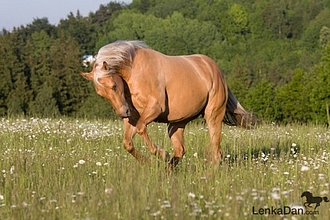
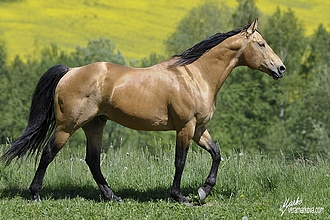
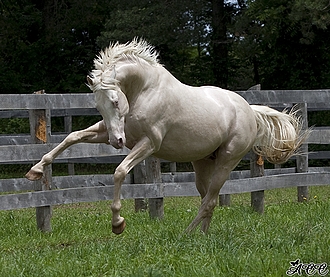
When only one C^Cr allele is inherited, the coat colour changes to yellow or golden. Only the red pigment (pheomelanin) is affected, while the black pigment (eumelanin) remains unaffected. When the resulting genotype contains two C^Cr alleles, both types of pigment are affected. The red pigment is completely diluted, and the black pigment is also subject to the dilution effect. The eye colour also changes to blue, and the skin becomes lighter, up to a pink colour.
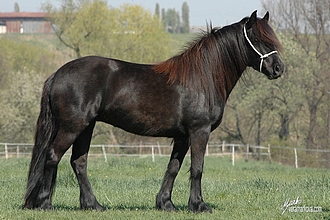
For clarity, the resulting coat colour types subject to different degrees of pigment dilution (based on the detected genotype) are shown in the following table.
| Basic coat colour | Genotype N/C^Cr | Genotype C^Cr/C^Cr |
|---|---|---|
| chestnut | palomino | cremello |
| bay | buckskin | perlino |
| black | smoky black | smoky cream |
.
2. C^prl allele (pearl)
The second allele of the C locus that affects dilution of the basic coat colour is the C^prl allele (pearl). The substitution mutation is located in exon 4 of the MATP/SLC45A2 gene (g.31709690G>A). The resulting phenotype is inherited in an autosomal recessive manner – for the pearl phenotype to be expressed, an individual must inherit two copies of the C^prl allele from its parents.
The resulting colour is very similar to shades produced by the CH allele (champagne) and by a heterozygous C^Cr genotype. The G allele (greying) may also have an influence. The phenotypic effects of these alleles are often virtually indistinguishable visually. The only way to determine which allele is responsible for the resulting phenotype is through genetic testing.
A special phenomenon is the compound heterozygous genotype of the C^Cr and C^prl alleles (pseudo-double cream). These individuals have very light to pink skin and a light coat colour. The eyes are usually blue or green. In purebred Spanish horses, these individuals are appropriately referred to as cream pearl.
It is likely that a large proportion of horses classified as cremello, perlino and smoky cream may also carry the C^prl allele in their genotype.
Breeds affected by the C^prl allele include: Iberian horse, Spanish horse, Lusitano, Quarter Horse and Paint Horse. In Paint Horses and Quarter Horses, horses with the C^prl/C^prl genotype are known as the “Barlink factor.”


In figure a), the colour expression produced by the C^prl/C^prl genotype during dilution of the original black colour can be seen. The resulting horse genotype is EE/Ee; A/a/Aa; Gg/Gg; C^prl/C^prl.
In figure b), the original bay colour is diluted and the resulting horse genotype is EE/Ee; AA/Aa; Gg/Gg; C^Cr/C^prl.
.
3. C^sno allele (snowdrop)
The third detected allele is the C^sno allele (snowdrop). It is located in exon 1 of the MATP/SLC45A2 gene (g.31688649G>A). The mode of inheritance is autosomal recessive. For the effect of the snowdrop allele to be expressed in the resulting phenotype, the offspring must inherit two copies of this allele from its parents (C^sno/C^sno).
The mutation causing coat colour dilution was identified in the Traditional Gypsy Cob breed.
.
4. C^sun allele (sunshine) – Genomia laboratory does not offer testing for this allele
The most recently detected allele of the C locus that affects dilution of the basic colour is the C^sun allele. The allele was identified in a Standardbred × Tennessee Walking Horse cross.
.
Palomino
.
Buckskin
.
Smoky black
.
Cremello
.
Perlino
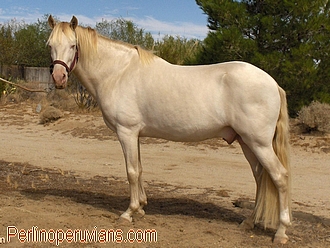
.
Smoky cream
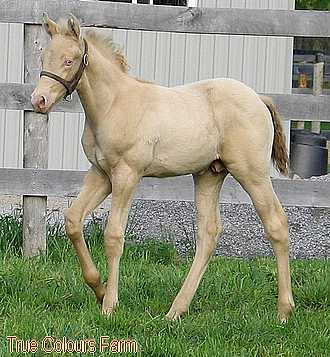
.
References
Bisbee, Danielle, et al. "Identification of a novel missense variant in SLC45A2 associated with dilute snowdrop phenotype in Gypsy horses." bioRxiv (2019): 851246.
Holl, H.M., Pflug, K.M., Yates, K.M., Hoefs-Martin, K., Shepard, C., Cook, D.G., Lafayette, C. and Brooks, S.A. (2019), A candidate gene approach identifies variants in SLC45A2 that explain dilute phenotypes, pearl and sunshine, in compound heterozygote horses. Anim Genet, 50: 271-274. https://doi.org/10.1111/age.12790
Mariat, Denis, Sead Taourit, and Gérard Guérin. "A mutation in the MATP gene causes the cream coat colour in the horse." Genetics Selection Evolution 35.1 (2003): 119-133.
Sevane, N., C. R. Sanz, and S. Dunner. "Explicit evidence for a missense mutation in exon 4 of SLC45A2 gene causing the pearl coat dilution in horses." Animal Genetics 50.3 (2019): 275-278.