

Genomia s.r.o.
Republikánská 6
312 00 Pilsen
e-mail: laborator@genomia.cz
» Contact & location


Tests for horses: Premium SNP DNA profile for horses
Genetic Profile
A genetic profile, sometimes referred to as a DNA profile, is a set of genetic markers that enables the unequivocal identification of an individual. A genetic marker is a specific part of the DNA genetic code that differs among individuals. A genetic profile remains unchanged throughout life and cannot be falsified or destroyed. It is used for individual identification, parentage verification, assessment of kinship relationships, and breeding optimization.
Applications of a Genetic Profile
Determination of a genetic profile serves as a reliable lifelong means of identification in many situations:
- Loss or theft of a horse — Enables verification of the horse’s identity if a lost or stolen horse is recovered.
- Microchip failure — If the horse’s microchip ceases to function, the genetic profile can be used to confirm the horse’s identity and allow re-chipping.
- Artificial insemination — Can be used for semen identification.
It is also used for parentage verification:
- Routine pedigree verification or parentage disputes — Provides reliable confirmation of paternity or maternity following planned breeding, accidental mating, or artificial insemination.
- Verification of “clear by parentage” status — If both parents have tested negative for a recessive genetic disorder monitored in a specific breed, and parentage is confirmed by genetic profiling, their offspring may be designated as “clear by parentage.” This approach is recommended for use only every other generation.
- Verification of other family relationships — If the parents cannot be tested, other relationships such as siblings, grandparent–grandchild, or uncle/aunt–nephew/niece can be evaluated. The more related individuals included in the analysis, the more accurate the probability of relatedness.
In breeding programs, genetic profiling serves as a tool for:
- Selection of optimal breeding pairs — Comparison of genetic profiles helps identify suitable combinations of individuals to maintain genetic diversity and reduce inbreeding within the population.
- Population studies — Monitoring genetic diversity, heterozygosity, and inbreeding.
Sample Collection
For genetic profile testing, blood samples are preferred. Sample collection is performed by a veterinarian, who simultaneously verifies the animal’s identity by scanning the microchip. The analysis is highly sensitive to DNA quality. Samples obtained by a buccal swab may also be used; however, they must be collected very carefully and stored in a breathable container to allow them to dry thoroughly. Pulled mane or tail hairs with intact roots may also be used for testing, provided that their quality is sufficient for successful DNA extraction.
Testing Methodology
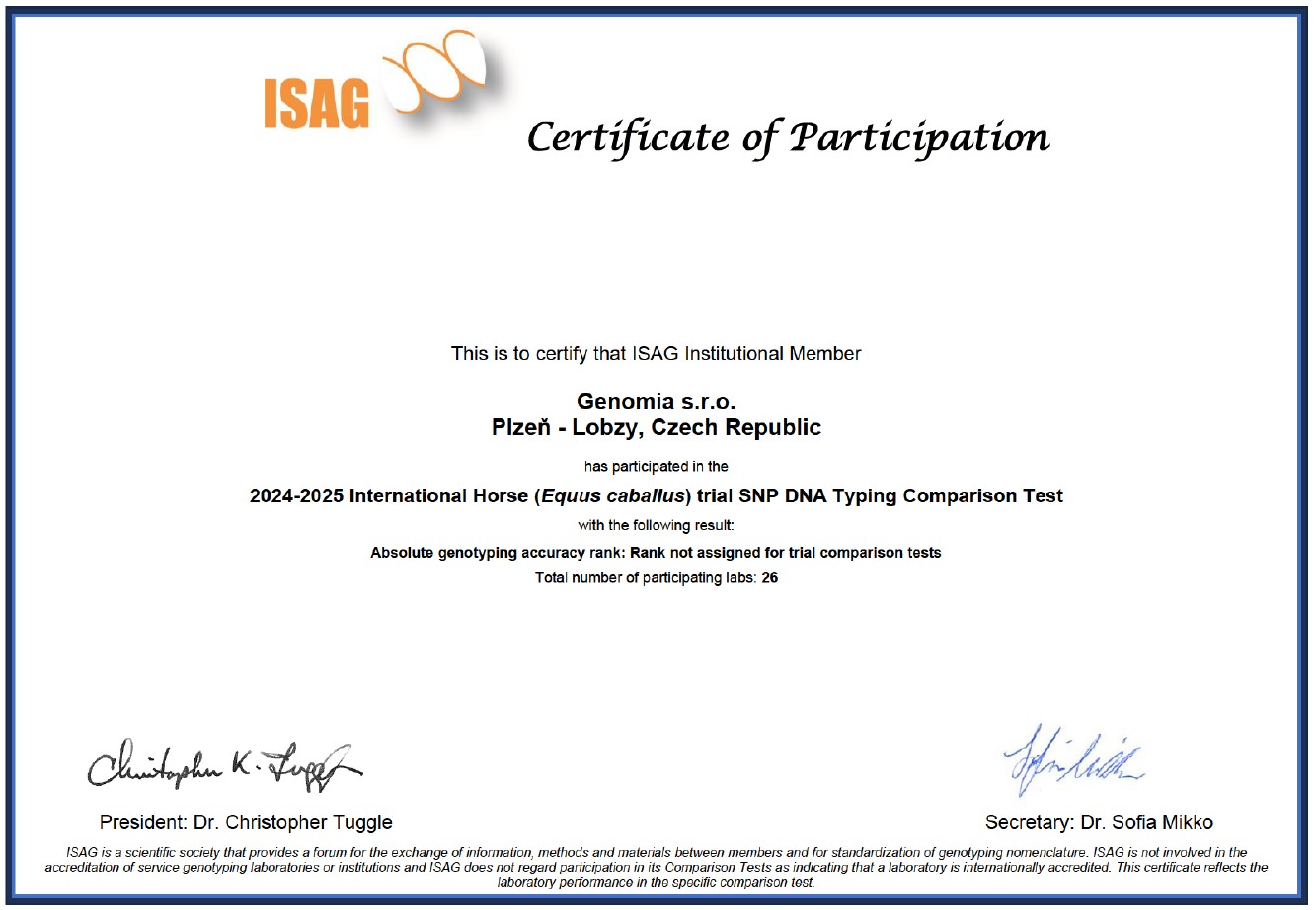
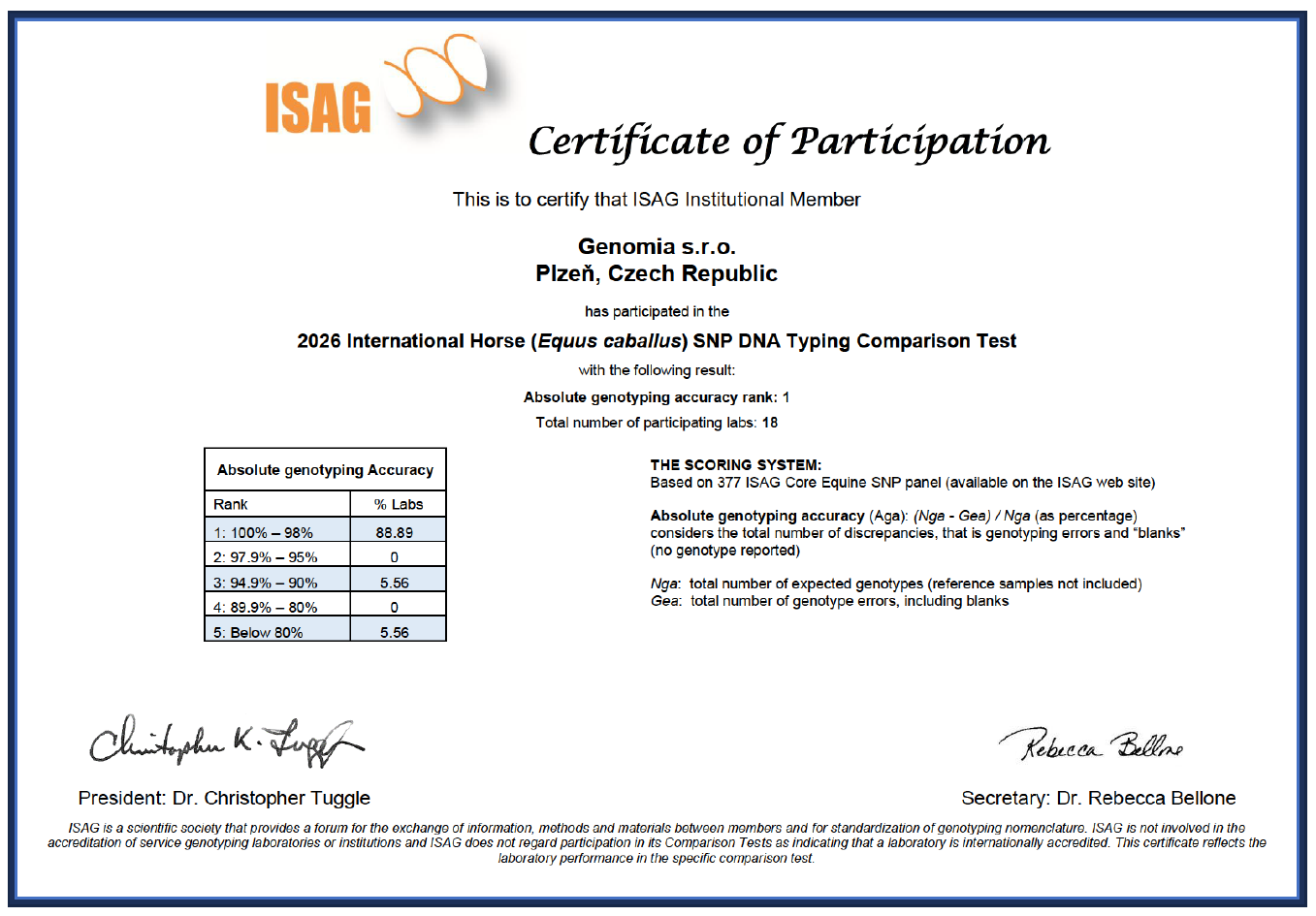
Genomia Laboratory uses the internationally recognized ISAG (International Society for Animal Genetics) standard, which is widely applied for genetic identification and parentage verification in livestock and companion animals, including horses. Genomia consistently achieves the highest quality ratings in ISAG proficiency tests. DNA profiling is accredited by the Czech Accreditation Institute according to ISO 17025, providing Genomia with the highest level of competence for equine DNA profiling.
Two main technological approaches are available for genetic profiling: STR and SNP. These approaches are not mutually compatible and their results cannot be directly compared.
SNP Genetic Profile
An SNP (Single Nucleotide Polymorphism) genetic profile focuses on the analysis of single-nucleotide variations within the DNA sequence. These variations are highly stable and inherited according to Mendelian principles, ensuring highly reliable, precise, and robust genetic identification.
SNP profiles are particularly suitable for population studies because they include a large number of markers distributed evenly across all chromosomes. This provides comprehensive genome coverage and a representative assessment of heterozygosity and genetic diversity. SNP profiling utilizes modern massively parallel sequencing technologies, increasing both the reliability and efficiency of testing.
SNP Analysis Workflow
DNA Extraction
Particular emphasis is placed on sample quality, with blood being the preferred sample type.
Massively Parallel Sequencing (MPS)
SNP analysis utilizes modern massively parallel sequencing technology, also known as next-generation sequencing (NGS), which enables the simultaneous analysis of hundreds to thousands of genetic variants.
SNP Marker Identification
Each SNP marker represents a specific position in the DNA where single-nucleotide variation occurs. ISAG2020 Panels 1 and 2 standardize the analysis of 859 SNP markers, enabling international comparison of results. Genomia guarantees reporting of at least 95% of these markers.
Bioinformatic Analysis
Following sequencing, the data are processed using bioinformatic software that determines the individual’s genotype based on the presence of specific SNP variants. Each SNP marker is reported as two nucleotides (“two letters”), one inherited from each parent.
Advantages of SNP Profiling
- Higher accuracy — Analysis of a larger number of markers distributed across all chromosomes enables more precise identification of individuals and assessment of kinship relationships.
- Greater marker stability — On average, one mutation occurs per 100 million bases per generation. By comparison, STR markers exhibit mutations approximately once every 1,000–10,000 transmissions of a given marker.
- Higher throughput — Hundreds of samples can be analyzed simultaneously.
- More suitable for population studies — Enables monitoring of inbreeding, genetic diversity, and homozygosity/heterozygosity. Genomia reports the heterozygosity value for every SNP profile.
The disadvantages include longer processing times and higher costs associated with analysis and the required technologies (high-performance computing, specialized evaluation software, large-scale data storage, and validation of MPS sequencing platforms). On the other hand, due to the high throughput of the technology, the cost per sample decreases as the number of tested samples increases.
STR Genetic Profile (ISAG2006)
An STR (Short Tandem Repeat) genetic profile is based on the analysis of microsatellite markers—short repetitive DNA sequences consisting of two to seven base pairs. The number of repeats varies among individuals and is inherited from the parents, making STR profiles an excellent tool for parentage verification and genetic identification.
STR Analysis Workflow
DNA Extraction
DNA is extracted from the sample and serves as the starting material for analysis.
Polymerase Chain Reaction (PCR) Amplification
Specific DNA regions containing STR markers are amplified using PCR. Each STR marker is selectively amplified using primers—short DNA sequences—with one primer labeled at the 5′ end with a fluorescent dye to enable product detection.
Electrophoretic Separation of Fragments
The amplified DNA fragments are loaded into a capillary electrophoresis instrument, where they are separated according to their length in an electric field. Each STR allele corresponds to a specific fragment length determined by the number of repeat units.
Detection and Data Analysis
Fluorescently labeled DNA fragments are detected by a laser scanner. The result is an electropherogram showing the length of each STR marker.
Interpretation of Results
The outcome is a unique combination of markers that identifies the individual. For each marker, one allele is inherited from the sire and one from the dam. Comparison of STR profiles enables verification of identity and confirmation of biological relationships with a reliability exceeding 99.99%.
.
.